

My 20-year Report: Finding our Happy Place

My 20-year Report: Finding our Happy Place

Jason Steed

Owner & CEO

My 20-year Report: Finding our Happy Place

Look, even our logo got a little happier!

Since opening Targa Media’s doors 20 years ago, I have given highest attention to the human aspect of business. In this post I will touch a little on company culture, but I’ll emphasize a few basic practices that have provided an unmistakable environment for trust, camaraderie, and yes…good old happiness. ;-]

Happiness and “team-focused” behaviors

In a breath, workplace happiness is all about recognizing the right behaviors. Caveat: The right behavior isn’t the same for everybody. Oh snap, this is going to take some time and attention! To help carve away the layers on that statement, I’ll elaborate with my only credible evidence: 20 years of personal experience.

Does the workplace even need to be a happy place? Taleen at the office pointed me just this week to a sound bite from Simon Sinek (source) who stated that we used to be able to gripe about the grind with friends after hours, serving as our prominent path to find bond and balance. But a deliberate shift has taken place due to the jarring post-COVID shift of our work environment and after-work social structure. Bottom line: Today there absolutely needs to be a sense of belonging and well-being during the span of our working days.

Behaviors that Promote Creativity

In our staff, I strive to recognize individual qualities. One employee might be adept at enabling more creativity from coworkers. Another might excel at helping to build trust among the staff. Somebody might have the skills to look out for the best interests of their team. Others might have the skills to be teachable and motivated. Maybe you spotted a trend—all of these items are much more about team collaboration than individual performance. This becomes much more clear when I describe the behaviors that I don’t reward.
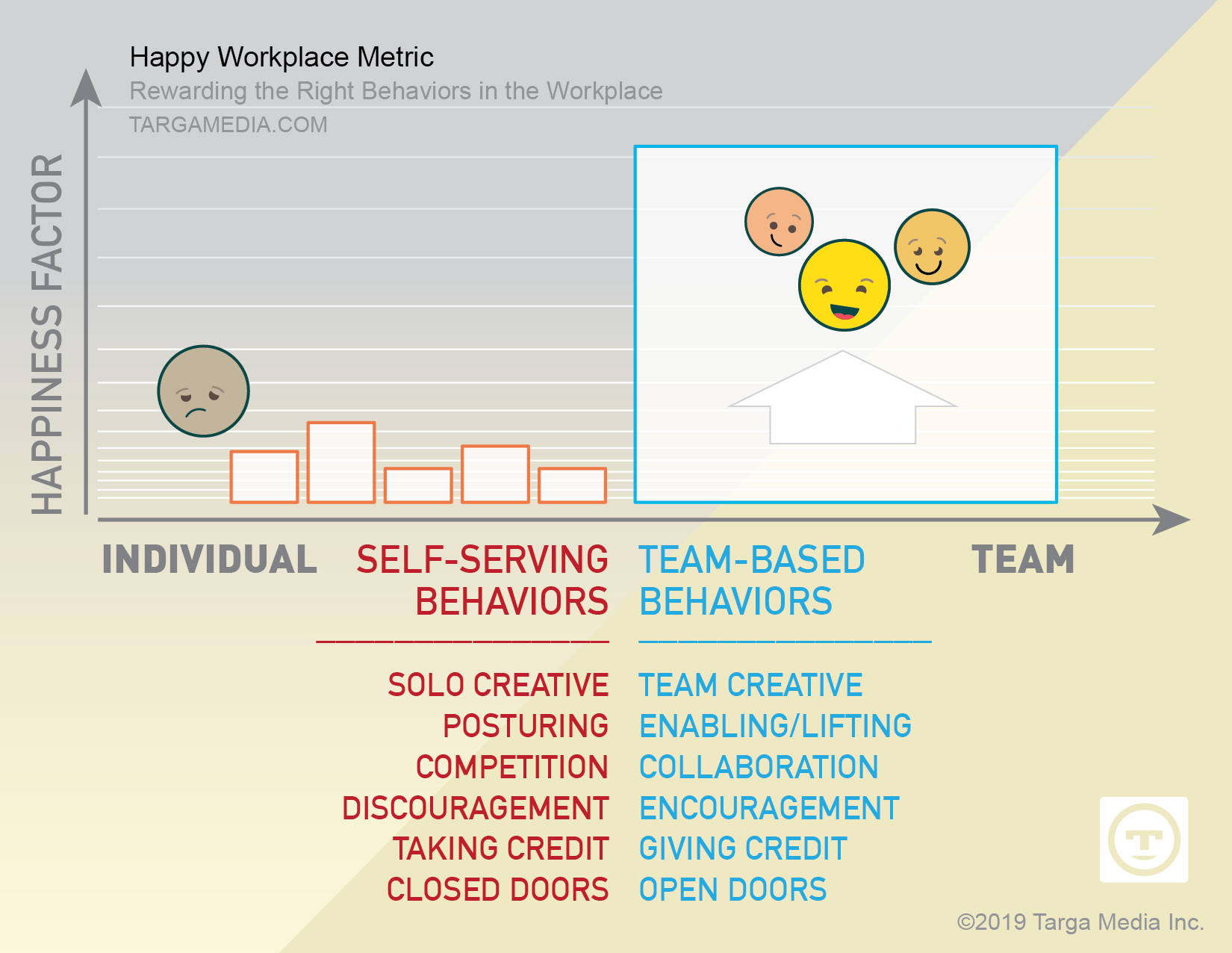
Happy Workplace Metric-TM1-1650
I want each of my employees to be “all in” for each other, not for me.

Bringing a Smile to Teamwork

Individual productivity is not the prize. It’s also not the pathway to a happy workplace. In a separate blog post I talk about fiscal productivity as the culprit for contention and a useless measurement for collective morale. To summarize, I enacted a Productivity Perks program in 2014 that looked not at percentage of billable hours but rather at extra-mile efforts to nurture camaraderie, creativity and gratitude. Efforts such as these “soft metric” contributions can often fly under the radar, making it hard to recognize and nurture. But for as long as I can remember as an entrepreneur and employer, I have sought daily to discern, recognize and help perpetuate these qualities. Admittedly, I’m sometimes hit and miss. I suspect I’ll be working at recognizing and refining these soft metrics for many years to come.

Job titles make for squishy rewards. Instead, I prefer to look at talents and capabilities that encourage teamwork. To distinguish between these, a job title is something that is manifested from employer to employee, whereas talents and capabilities are manifested from employee out to their work circles. In essence, we’re creating “team titles,” along with a little help from our clients.

I love the good that comes from our collective creativity. Individually, we can come up with great ideas. However, our team authors a powerful “collective” creative portfolio. In this model, our clients benefit from far more effective marketing campaigns. When we huddle, our team is so much more vibrant and creative than the sum of our individual parts.

I don’t pay my gratitude solely through salary. It’s both vital to employee engagement and innately important to me personally that I applaud in ways beyond monetary salaries and bonuses. Although money is a powerful tool in showing value, it is only a part of the formula. If it were only about money, I wouldn’t be able to afford any of my talented staff. I happily shoulder the attentive tasks of finding non-monetary ways to recognize and reward our team. I’ll speak on this more specifically in a later blog post.

I don’t recognize staff for allegiance to our company vision. We’re all individual, and as a business owner I recognize that I have a lot more skin in this game than other team members. To be clear, we still must all share a common loyalty to the moral and humanistic rules that let us feel secure, valued, and respected. The motivators that ready each of us for the workday are always personalized to our individual goals and trajectories. In fact, it’s actually the variety of these individual motivators that propel our firm’s mission and vision statements. I want each of my employees to be “all in” far more for each other than for me.
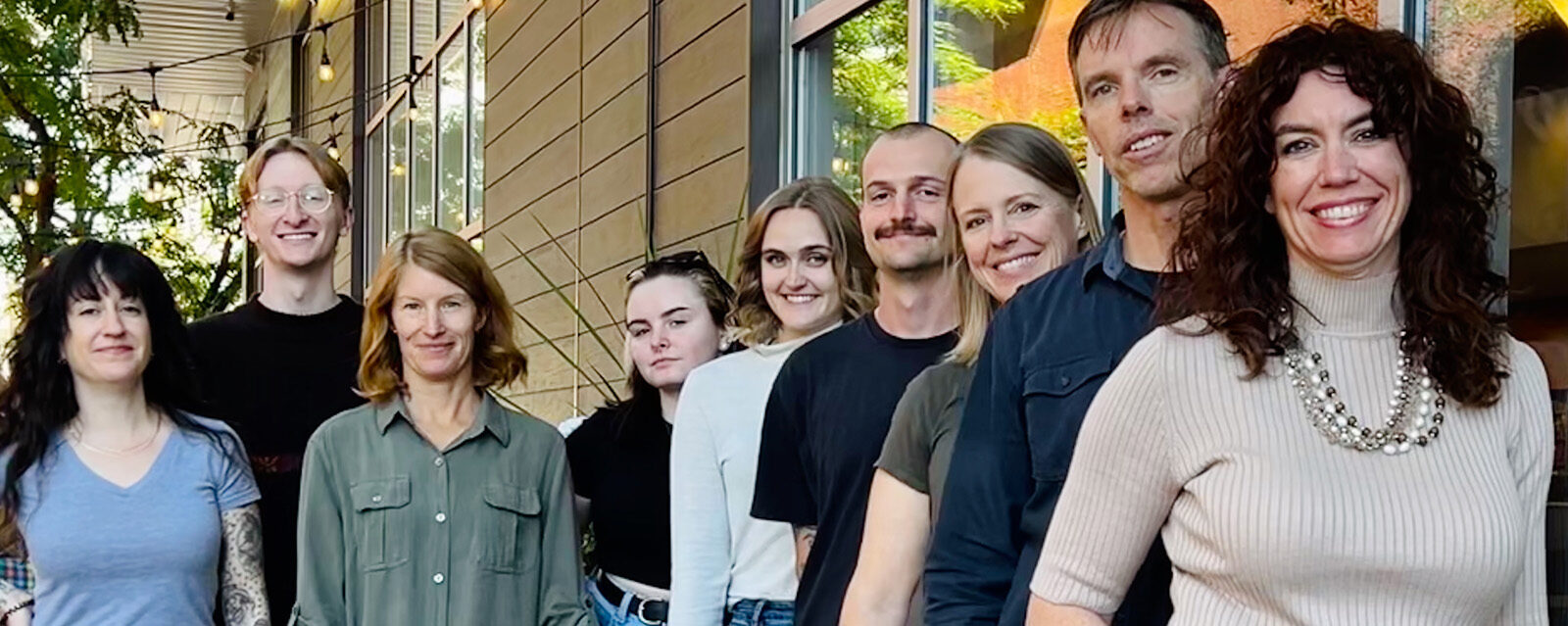
Targa Media team-porch1 Maddie Gray Taleen Ericksen Jason Steed Rachel Klein
“In a breath, workplace happiness is all about recognizing the right behaviors. Caveat: The right behavior isn’t the same for everybody.”

Five Humble yet Happy Workplace Tactics:

Though always in flux, here are a few of our current programs and practices that help to promote a happier workplace:.

  1. “Best weekend” report: Just a casual top-of-week catch up on each of our weekend events. Simple, but a great way to set the stage for the week. I confess that my weekend adventures seldom top the leaderboard.
  2. Daily virtual/physical face-to-face status huddles with the entire staff. I’m grateful that our company size allows us to logistically accomplish this each and every day. Taleen, our Chief Program Manager, started this practice as a sanity check during deep COVID 2020, and it stuck! Whether on a daily or weekly cadence, businesses would be well-served to adopt a comparable “everybody in” policy.
  3. We utilize “full team” Google Chats, and we discuss both work-related and non-work-related topics. Just as importantly, we respect team members taking the day off with custom exclusion Chat lists.
  4. Open door policy – My management team and I always keep our office doors open, other than for the occasional video call when the office volume is up.
  5. I share client feedback—both the wins and the losses—with the creatives who lead the project, as well as the whole staff. In this way, I believe we can better one another. Furthermore, it’s our chance to show clients how unified we are as a team on their behalf.

Bottom line: Today there absolutely needs to be a sense of belonging and wellbeing during the span of our working days.
My First Demotion, and How it Steers Me Today

My First Demotion, and How it Steers Me Today

Jason Steed

Owner & CEO

My First Demotion, and How it Steers Me Today

Allow me to share what I’ve kept pretty much to myself for over 24 years: my first demotion. A year into my first job out of school, my boss invited me into his office for an annual performance review. He delivered a job title demotion from Associate Art Director to Production Designer. I didn’t see that coming. Or did I? Now, more than 24 years later, I’m realizing how powerful that demotion was in crafting my work ethic and daily intentions as an entrepreneur.

Navigating my First Ad Agency

Right out of school, I was hired by DSW, the largest ad agency in Utah. I very much enjoyed my time among so many creatives. I shared an office with another out-of-school Associate Art Director. She and I didn’t interact much, in fact I pretty much kept to myself as I designed Intel web pages using their highly-restrictive blue and orange color palette along with Helvetica Neue Bold Extended (with the bold checkbox checked). Yep, that was my one account, and that was my only allowed color/font combo.

Intel Inside 1997 art directing website
I loved watching over shoulders as the production team edited long strings of code to produce my visual end product. In fact, I spent a lot of time observing various teams working on video, print, media buying, and administration. I wanted to piece together the path that a project takes from idea to delivery.

I Felt Called Out

Following my annual review and job title demotion, I remember feeling called out, as though I had taken something from somebody, and now they wanted it back. I was embarrassed, upset, and confused, unsure of what to do next. I put in my 2-week notice and disappeared. I suppose I felt guilty for doing something falling short of what my job title specified. I can’t say, for certain, why my managers made the decision to change my role. I speculate that I wasn’t proactive enough with design guidance to the production team. I do feel, though, that I was doing what was asked of me. I wasn’t sure whom I was letting down, other than myself. I avoided much-needed guidance from peers and mentors.
“I felt called out, as though I had taken something from somebody, and now they wanted it back. I was embarrassed, upset, and confused, unsure of what to do next.”

A Job Demotion, or a Job Correction?

I’m not sure I was living up to my title as “Art Director” since I certainly wasn’t art directing anybody. in fact, I wasn’t even art directing myself. I was more of a process analyst, following projects along their production lines. My new title of Production Designer was certainly a better fit for my hands-on inclination. I was functioning very much as a technician, and I was feeling comfortable in that space. I guess I was just too proud to let somebody else point that out and assign it.

How my First Demotion Changed my Trajectory

Since that 1998 demotion interview, I’ve recommitted over and over again to better understand the positions I was hired to fill. For some reason, it’s been hugely important for me to understand why I’m valuable. Just as I took interest in the project lifespan assembly line, I’ve shown up with intention to be that important cog in the creative process. Moreover, if I felt my skills could bleed over into other parts of the creative chain (which has certainly been the case) then I would discuss those ambitions with the team and leadership.

Today’s Takeaways from a Long-ago Demotion

  • Exceed expectations
  • Show up for yourself and others
  • Seek mentors—they’re all around us
  • Recognize your important role in the creative assembly line
  • Plug yourself in to new places
  • Call yourself out before you get called out
  • Be the giver and the receiver in your job titles and roles
  • Take the time to understand why you’re valuable
  • Let daily intentions fuel lofty goals

A Springboard for Growing my Entrepreneurial Legs

This series of events was ultimately a blessing. Stepping out of a very large agency and into smaller design boutiques allowed me to become involved in many facets of projects—from client to concept to completion…then to customer..

Customer Advisory Board: The Business Lifeline for Small Businesses

Customer Advisory Board: The Business Lifeline for Small Businesses

Jason Steed

Owner & CEO

Customer Advisory Board: The Business Lifeline for Small Businesses

The fundamental shift from shareholder to stakeholder is the new guiding principle behind business success or failure. Whether a virtual process or a structured program, a Customer Advisory Board is a company’s conduit to product development, company branding, and business profits. The Board is also in charge of finding a personalized business liability insurance that works best for the company. And for industries from technology to brick and mortar, it’s a process that can and must be put into place immediately.

Customers and prospects will be more successful at answering industry trends, business drivers, customer issues, and market opportunities than your smartest employees. Organizations who listen to the right people then act swiftly on that feedback are building relevant products and gaining market share. Not all customers are the “right people,” though.

Some customers are just as capable of providing poor, misinformed, or short-sighted advice. What, then, determines a qualified or informed customer? A common assumption is to start with the biggest spenders in your database. A word of caution: cash cows are not always your strongest advocates. In fact, your best customers might be slow spenders, or they might not have purchased anything from you at all. Consider yourself. Are you quick to spend money, even with a company you trust?

In addition to trust, good board members are influential, informed, inquisitive, critically-minded, and loyal. Your customer advisory board is loyal to their community of friends, not to you or your products. If you can provide them with tools to serve their community then you’ve earned a customer for life. More importantly, you’ve earned qualified referral business. I also mentioned “critical.” You will greatly benefit from customers who call you out when you blunder, or who challenge you on a flawed policy change. These individuals are invested in you and your service offering.

Unlike a generic target audience or demographic, you should choose people whom you know, and who know you. You only need to assemble a few for each major category of products or services. These are spokespeople for your business, your products, your staff, and your company vision. They have the ability to manage your company’s brand.

What do you do with your Advisory Board? For starters, you don’t inundate them with obligations. A quick casual conversation will yield more valuable insight than any online survey. Many sophisticated surveys only provide answers to “your” questions, when in fact they may not be the right questions to start with. Don’t forget that their loyalty is with their peers and internal support groups. Following these types of conversations is more powerful than direct conversations with them. How do you follow these conversations? Provide them with a place to talk with like-minded individuals, or join their online communities. Social media makes meaningful conversations extremely accessible. Unlike eavesdropping, your customers WANT to be heard. They hope that their opinions and insights matter enough to grab the attention of somebody who’s in a position to bring those changes to light.

Action Items

Ask your customers whom they want to interface with in your organization. Involve as many as possible, but organize feedback so that it gets consolidated and acted upon. Set up an online community, or utilize existing social media channels to follow pertinent conversations.

Case Study

If you own an iPhone, you’ll understand this principle more fully. Apple spent more time with their street-smart customers than in researching the competition and employing leading technology minds. The iPhone is not merely an upgrade to smartphone technology. It’s a tool for anticipating the needs of its users, i.e. the number of seconds it pauses before auto-filling a word, or user-defined suggestions from common misspellings, or its programmed “wiggle room” for irregular human-touch commands. Unlike the competition, the technology doesn’t run ahead of hand-eye coordination. iPhone technology is built to be a conversation with its user. This is customer feedback in action.