

Five Signs It’s Time to Outsource Part of Your Marketing

Five Signs It’s Time to Outsource Part of Your Marketing

Jason Steed President and CEO at Targa Media

Heather Steed

Graphic Design & Marketing

Five Signs It’s Time to Outsource Part of Your Marketing

Growth is usually a good problem to have—until your marketing team becomes the bottleneck. Campaign ideas sit in the backlog, sales requests keep piling up, and the same few people are asked to handle everything from strategy to execution. Hiring more employees may seem like the obvious answer, but it isn’t always the most practical one. Sometimes the smarter move is to bring in outside support for the work your team doesn’t have the time, capacity, or specialized expertise to manage.

Outsourcing part of your marketing means recognizing where extra support could help your internal team focus, move faster, and do its best work.

So, how do you know when it’s time to outsource part of your marketing? Consider outside support when important work is repeatedly delayed, too much responsibility rests with one employee, or you need specialized expertise. Other reasons to bring in outside help include problems with production requests  crowding out strategy, or a major initiative that exceeds your team’s normal capacity.

Sign 1: Important projects keep getting pushed back

Remember that marketing campaign your team was planning a month or two ago? Has it stalled under the pressure of requests from sales or other departments? Your team may be full of creative plans but constantly asked to pivot to other, equally important tasks.

a person juggling too many projects

What was once an efficient operation producing campaigns, sales materials, and customer communications may now be struggling to keep up. When growth increases the pressure on marketing, work can become rushed or even be released before it meets the team’s standards. In the meantime, important projects keep falling behind. This is often one of the first signs that your team could use some overflow marketing support.

Sign 2: You’re relying too heavily on one person

Initially, your company may have done well with its small but mighty marketing force of one. But lately, demand has started to outpace capacity.

When one person handles strategy, writing, design, email, web, and project management, the whole engine can stop when they’re pulled into another priority. It also hapeens when they take a vacation or sick leave. Important processes and ideas may live only with that individual, putting valuable knowledge at risk if they move on or become unavailable. That person is also more vulnerable to burnout, which can affect both the pace and quality of the work. Even the most capable and brilliant employee isn’t exempt from these risks.

    Sign 3: You need expertise that doesn’t justify a full-time hire

    Perhaps your department effectively handles your everyday marketing strategy, design, and email but needs help with web development, video, or another specialized area. It’s not a 40-hour-a-week shortfall, and it may not make sense to hire a full-time employee for work you only need periodically.

    In other cases, your team may spot a larger opportunity that would require an entirely new set of skills—and hiring and training a new team could take long enough for that opportunity to pass. In either situation, an outside partner can provide the expertise you need without requiring you to build a permanent team before the work can begin.


    Sign 4: Your in-house marketing team is becoming a production department

    In this scenario, your marketing team finds itself spending nearly all its time responding to urgent requests and one-off projects. The work needs to be done, but it also pulls the team away from planning, evaluating what’s working, and thinking about what should come next.

    When asset requests fill the schedule, there’s little room left for the work that helps the business grow. And when the priority becomes producing more rather than producing work with a clear purpose, the brand and its messaging can become inconsistent.

    Sign 5: A major initiative is stretching the team too thin

    Sometimes marketing teams become overwhelmed because there is simply too much good work to do. Maybe you’re launching a new product, hosting a major event, or bringing a newly acquired company and its products into the fold. Or perhaps one campaign is simply too large or labor-intensive for your current team to handle alongside everything else.

    A six-month push may require more capacity—or different expertise—than you normally need. It’s a good problem to have, but still a tricky one to solve. If your team can only take it on by putting everyday marketing on hold or working at an unsustainable pace, bringing in outside help can give everyone a little more breathing room.

    a person being stretched in too many directions

    Give Your Team the Support It Needs

    Recognizing one of these signs in your team doesn’t necessarily mean you need to replace your current approach or hand your entire marketing operation to an agency. You may simply need marketing support that can step in during a demanding season.

    The right outside marketing partner should make your internal team stronger, help important work move forward, and adapt to the way your business already works.

    Would we be a good fit?

    We work best with teams that need thoughtful, flexible support without a lot of unnecessary process. Sometimes that means helping shape an idea from the beginning. Other times, it means taking a well-defined project and getting it across the finish line.

    We can provide specialized expertise, extra capacity, or simply more hands when the work starts piling up. And we do it all while learning your brand and working as an extension of your team.

    If that sounds like the kind of help you need, let’s talk.
    Marketing + Sales Enablement: How Alignment Drives Revenue

    Marketing + Sales Enablement: How Alignment Drives Revenue

    Jason Steed President and CEO at Targa Media

    Heather Steed

    Graphic Design & Marketing

    Marketing + Sales Enablement: How Alignment Drives Revenue

    For years, Marketing and Sales have been cast in a familiar tug-of-war.

    Marketing wonders why Sales isn’t using the leads, messaging, or content they worked hard to create. Sales wonders whether Marketing really understands the questions and objections buyers are bringing into actual conversations.


    Meanwhile, opportunity gets lost somewhere in the handoff.

    Sales Enablement can help close that gap.

    When Marketing and Sales Enablement work together, they create a stronger connection between generating interest and helping sales teams turn that interest into productive buyer conversations. It’s less about handing leads and assets over the fence and more about building a connected system around the buyer.

    You could call them the new revenue power couple.


    What is Sales Enablement?

    At its simplest, sales enablement gives sales teams the content, training, tools, information, and guidance they need to have better conversations with buyers.

    Salesforce describes sales enablement as a combination of content, coaching, training, and technology designed to help salespeople improve their skills and sell more effectively.

    That makes Marketing and Sales Enablement natural partners.

    Marketing understands the audience, develops positioning, builds campaigns, and creates buyer-facing content. Sales Enablement helps translate those resources into something sellers can actually use: training, sales plays, conversations, and tools that support the buyer at different stages of the decision process.


    Why Marketing Needs Sales Enablement

    Marketing can develop a compelling brand story and create campaigns that get the attention of the right buyers. But that work only goes so far if sales reps aren’t prepared to continue the conversation.

    Sales Enablement helps turn marketing strategy into usable sales behavior.

    Keep the message consistent

    A campaign may introduce a specific value proposition, buyer problem, or product story. Enablement helps make sure sales teams understand that positioning and have the right pitch decks, talking points, and supporting materials to carry it forward.

    The buyer gets one connected story instead of a marketing message followed by an entirely different sales conversation. That consistency matters across internal teams and outside partners, too. Here are some practical ways to outsource marketing without losing brand control.


    Make good content easier to use
    That means organizing content around real buyer needs, industries, personas, objections, and stages of the sales process. HubSpot similarly recommends developing stage-specific enablement resources based on what buyers and sellers need to move a conversation forward.

    Prepare sales before the campaign launches

    Marketing often spends weeks or months developing a campaign only to involve Sales near the finish line.

    Enablement gives companies an opportunity to reverse that sequence.

    Before the campaign goes live, reps can understand the audience, positioning, offer, likely objections, available resources, and recommended follow-up. When buyer interest starts arriving, Sales is already prepared to act on it.


    Why Sales Enablement Needs Marketing

    The relationship goes both ways.

    Sales Enablement can’t build useful training and sales plays in isolation. It needs the customer insight, market perspective, positioning, and content expertise that Marketing brings to the table.

    Marketing can support Enablement with:

    Buyer insights. Campaign performance, audience research, customer interviews, and message testing can help identify which problems and ideas are resonating.

    Purpose-built content. Case studies, competitive materials, ROI tools, product sheets, presentations, and vertical-specific assets give reps credible material to support their conversations.

    Clear positioning. Product launches and campaign initiatives work better when sales teams understand not only what is new, but why it matters to a particular buyer.

    Marketing builds the story. Enablement helps sellers know when and how to tell it.

    The Feedback Loop That Makes Both Teams Better

    This is where the partnership gets particularly valuable.


    Sales conversations produce information that Marketing can’t always get from campaign analytics alone.

    • Which questions keep coming up?

    • Which claims require more proof?

    • What objections are slowing conversations down?

    • Which case studies get a buyer’s attention?

    • Where are reps struggling to explain the value?

    Sales Enablement sits close enough to those conversations to identify patterns and bring them back to Marketing.

    Marketing can then use that information to refine messaging, fill content gaps, improve campaigns, or rethink how a product or service is being positioned. The result is a continuous loop:

    Buyer and Sales Feedback → Better Marketing Assets → Better-Equipped Sellers → Better Buyer Conversations → New Feedback

    Instead of Marketing creating materials and hoping they work, both teams learn from what actually happens in the field.

    3 Ways to Strengthen Marketing and Sales Enablement

    You don’t need to reorganize the company to make this partnership work better. A few operational changes can make a significant difference.

    1. Build a shared launch calendar

    Coordinate campaign launches, product announcements, content development, and sales training.

    The important part is sequencing. Sales teams should understand a campaign and have the resources to support it before prospects begin responding to it.

    2. Create one source of truth for sales content

    Give reps one reliable place to find current buyer-facing assets, internal playbooks, messaging, and product information.

    And keep it clean.

    A centralized library filled with outdated versions isn’t much better than having materials scattered across five different platforms. Assign ownership, archive old assets, and organize materials around how Sales actually works.

    3. Create a System to Keep Sales and Marketing Aligned
    Set up a recurring conversation between Marketing and Sales Enablement that goes beyond project status. Set up a recurring conversation between Marketing and Sales Enablement that goes beyond project status. As we learned while rebuilding our own website, a regular feedback cadence can reveal misalignment early and prevent teams from spending time on the wrong solution.

    Review questions such as:

    • What content are reps actually using?
    • What are buyers asking about?
    • Where are deals getting stuck?
    • What objections are appearing more frequently?
    • What content or tools are missing?
    • What have recent campaigns taught us about buyer interest?

    Those conversations give both teams better information for deciding what to create next.

    Better Alignment, Fewer Dropped Handoffs

    Generating interest is only one part of the revenue process.

    Companies also need to carry the right message, information, and buyer experience from the first marketing touchpoint into the conversations that follow.

    That’s where Marketing and Sales Enablement work best together.

    Marketing brings the audience insight, strategy, positioning, and creative resources. Enablement helps turn those ideas into usable tools and repeatable sales behaviors. Sales brings real-world buyer feedback into the loop.

    The opportunity isn’t simply to create more marketing or more sales content. It’s to build a system where each part makes the others more effective.

    Jason’s Take

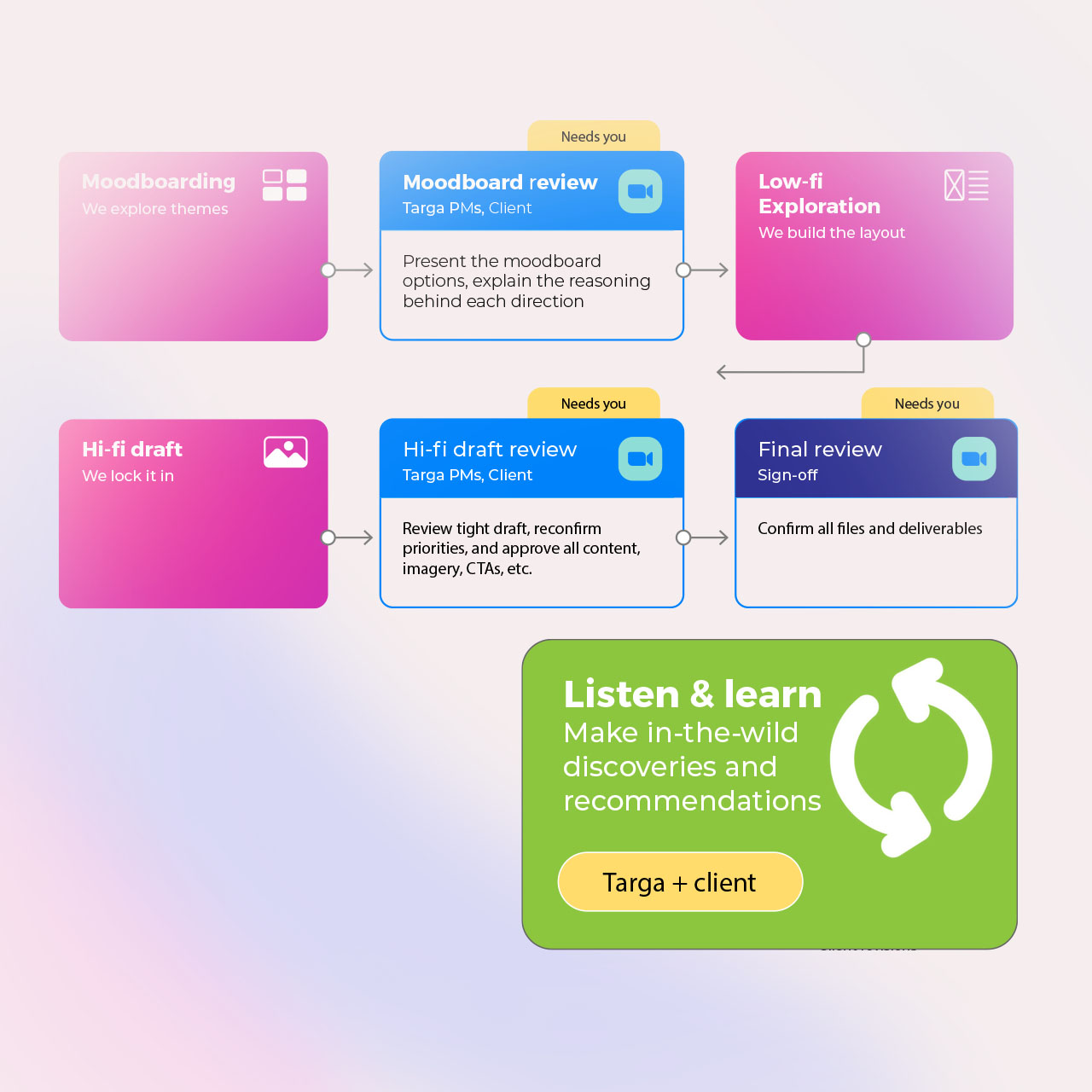
    Here’s how we’re using a feedback loop with every project, and how we go beyond sales + marketing to involve the client in our Listen & Learn strategy. This model applies from a standalone social graphic to an expanded multi-month campaign. I shared just this week in a presentation to a client of ours how their project managers can listen to campaign signals and share success metrics with my leadership team. Their feedback becomes Targa’s KPIs, making creative decisions from the wild instead of inside a box.

    How to Outsource Marketing Without Losing Brand Control

    How to Outsource Marketing Without Losing Brand Control

    Jason Steed President and CEO at Targa Media

    Heather Steed

    Graphic Design & Marketing

    How to Outsource Marketing Without Losing Brand Control

    You’ve worked hard to make your business successful, and your client base has come to know your brand. In fact, you’re now so successful that your marketing department is feeling the heat. Growth creates an interesting problem for small businesses: the marketing that helped you grow can eventually become too much for your internal team to manage. It’s a good problem to have, but a problem nonetheless. That’s often when outsourced marketing starts to make sense. The right partner agency can build on your brand knowledge, helping you maintain and expand your marketing efforts and reach your business goals without burning out the internal team.

    Decide What Kind of Support Would be Most Helpful

    For many small businesses, the best solution is a hybrid model that keeps strategic ownership in-house while adding outside expertise where it’s needed most. There are some things you will want to keep in-house, like brand direction, business priorities, customer knowledge, product expertise and final strategic decisions. But there are other things that an outside agency can help with: campaign development, graphic design, content production, digital execution, email and social, web projects, specialized marketing expertise, and overflow capacity. A good partner fills in the gaps without trying to take over the marketing department.

    Get Clear About Your Brand First

    Before bringing in outside help, it’s important to be clear about your brand. If you’re still figuring some of that out, a creative agency can actually help with that too. But there’s an important difference between asking an agency to help you define your brand and asking them to go out and represent it. Before they can do the second one well, everyone needs to understand what the brand is. The Small Business Administration recommends doing some groundwork before executing a marketing plan, including creating a description of your target market, competitive advantages, marketing goals and how you’ll measure success. In addition, here are some questions about your brand and products that you can answer:

    • Who are we trying to reach?
    • What problem do we solve?
    • What makes us different?
    • What should our brand look and feel like?
    • What are our most important messages?
    • What are we trying to accomplish?

    If you can answer all of those questions, you are likely ready to hand off some of your marketing to an outside agency without losing brand direction.

    Create Guardrails, Not Handcuffs

    The goal isn’t to hand your new agency a giant rulebook and tell them not to color outside the lines. You hired them because you wanted their expertise and creativity. But they also shouldn’t have to guess what “on brand” means to you. Good brand guidelines protect consistency without eliminating judgment. Your partner agency should understand what must stay fixed and where there is room to explore. Here are some resources you could provide to your new marketing agency to help them follow and maintain brand consistency:

    • Logo, typography and color standards
    • Brand voice
    • Core messaging
    • Good examples
    • Bad examples
    • Photography or illustration style
    • Words or claims you avoid
    • Audience definitions
    • Competitors and category context

    A solid brand foundation helps your partner move faster, make better creative decisions, and maintain consistency across campaigns.

    Give Feedback Early and Often

    At Targa, we follow a model that we believe gets us to the correct solutions faster than traditional marketing agencies. Instead of disappearing with your design brief and returning weeks later with a “big reveal,” we prefer to share our thinking earlier in order to prevent time wasted on the wrong ideas. Our philosophy is earlier communication, better outcomes:

    Campaign Brief → Early ideas → Discussion → Refinement → Execution.

    We’ve found that showing ideas early—even when they aren’t polished yet—can save everyone a lot of time. A client can tell us, “Yes, that feels like us,” or “No, we’d never say it that way,” before hours have been invested in taking the idea to completion. Brand control doesn’t come from approving every comma, it comes from staying connected to the thinking behind the work. In a recent call with one of Targa’s Fortune 500 clients, our team received updated guidance around their evolving brand refresh—including some visual choices they were leaning into that had previously been off the table. They meet with support agencies like ours on a regular basis in order to keep us informed and up to date. Because we learned about those changes in advance of their implementation, we could apply the new direction to work already underway rather than finding out after the designs were finished. This kind of ongoing communication helps us represent the brand accurately as it changes. We saw the same principle at work while our team was rebuilding our own website, where regular reviews helped us catch misalignment early and make better decisions together. 

    Give Your Marketing Partner Context, Not Just Assignments

    Usually, the more we understand about why you’re asking for something, the better we can do the work. Tell your agency why the project matters, what you’ve tried before, what worked (or didn’t), and the result you’re hoping for this time. And don’t forget your sales team. They may know things about customer questions and objections that can help shape the campaign. Creating a regular feedback loop between Marketing and Sales Enablement can help turn those insignhts into stronger messaging and more useful campaign insights. The more your agency knows, the better informed their work will be.

    There’s a big difference between saying, “We need an email campaign,” and explaining what the campaign needs to accomplish. Maybe customers are confused about a feature. Maybe sales needs more demo requests. Maybe research shows that one product benefit matters more than the others. That context gives your agency something to solve—not just something to make.

    Decide Who Gets to Decide

    Even with a great agency relationship, somebody eventually has to be the person who says, “Yes, this is approved.” When too many people veto power, it can get in the way of moving the work forward, so figure out who has final approval before the first project gets underway. Who will assign work to the agency? Who will be the touchpoint for approvals and edits? Decide which types of decisions will be left to the partner agency and which will stay in-house. This will prevent unnecessary confusion, extra review cycles and the frustration of a campaign going in circles because the process was not well defined.

    Choose a Marketing Partner that Wants to Learn Your Brand

    Look for a marketing partner that genuinely wants to understand your brand—not simply apply its own style to your work. A good agency will ask questions about your customers, business goals, sales challenges and past marketing, not just timelines and deliverables. In other words, they will be curious. They should be able to explain the thinking behind their recommendations and adapt to your brand rather than forcing you into a house style.

    Keep the Brand, Lose Some of the Workload

    Outsourcing marketing shouldn’t feel like handing your brand over to strangers and hoping for the best. The right partner doesn’t take ownership of your brand. They learn it well enough to help you protect it, strengthen it and put it to work.

    Would we be a good fit?

    We pride ourselves in learning your brand. If we’re a good fit, we’ll help you with your marketing. We’re an extra set of hands, showing up when it’s all hands on deck. Let’s connect and find out →

    2026 Graphic Design Trends: Why Personality Wins

    2026 Graphic Design Trends: Why Personality Wins

    Heidi Blackburn

    Heather Steed

    Graphic Design and Marketing

    2026 Graphic Design Trends: Why Personality Wins

    A few years ago, you could spot a brand with a seasoned creative team from a mile away. Today, that boundary is incredibly blurry. High-powered digital design tools have made clean, polished layouts accessible to everyone. While that’s an advantage for quick turnarounds, it also means a visually pretty design isn’t enough to grab anyone’s attention anymore.
    The most important creative shift this year isn’t a specific color palette, a trending typeface, or an illustration style. It is a fundamental pivot in what people value once everyone is using the same kinds of tools.

    AI Continues to Change the Rules

    For a long time, good design was heavily judged by technical execution. If you had the specialized skills to build clean vectors and perfect compositions, you won the room. Today, that execution premium has shrunk dramatically. Platforms like Canva, Figma, and Adobe Firefly have dramatically lowered the barrier to making professional-looking content.

    This isn’t a bad thing. It frees creative teams from spending all their time making assets and gives them more time for strategy, which ensures design goals are met. The downside? Polished design is increasingly a commodity. Effective visual communication is the real luxury.

    The Shift Toward Human-Centered Creativity

    Because generative tools are incredibly good at mimicking polished aesthetics, authentic human work has become a premium asset. We all appreciate the raw efficiency of the technology, but nobody wants their brand to look like a generic corporate template. In an ecosystem where a machine can simulate a safe, sterile voice flawlessly, the work that keeps a distinct human perspective is what wins.

    Josh McCowan, a designer here at Targa, put it clearly:

    “The explosion of AI-generated content has created a new hunger for authenticity, not just in marketing, but anywhere design plays a role. For us, AI speeds up exploration, removes technical and artistic barriers, and gives us new ways to refine our work. But the same widely available tools that expand creativity have also introduced a new kind of sameness. Clichés can appear almost overnight. That puts a greater premium on judgment, taste, restraint, and genuineness, all qualities strong marketers and designers bring to their work. AI has been a major benefit, but standing out still requires knowing when and how to use it, and when to push beyond its limits.”

    When we evaluate our work today, the question shouldn’t be “Is it clean?” but rather “Does it feel human?” That means prioritizing:

    • Real personality over corporate safety
    • Organic imperfections over sterile, mathematically perfect vectors
    • Self-aware humor and hyper-local context
    • Lived experiences and unedited photography
    • Distinct opinions or points of view
    • Clear, concise language


    As AI literacy grows, knowing when not to use AI may become just as important to brand perception as knowing how to use it well. These are the creative boundaries where prompt-based often generation falls flat. They are the details that make a piece of creative work memorable and unexpected.

    Why Authenticity Matters in AI-Era Design

    If a campaign manages to make someone pause and feel an actual emotion, they are much more likely to remember the brand. Historically, companies tried to walk a safe middle ground—they wanted to look distinct, but never risky or unfamiliar. The current tech landscape turned that logic upside down. When everyone plays it safe with polished AI templates, they end up blending into a wall of background noise.

    Brands that incorporate playful experimentation, surreal concepts or distinctive illustration styles end up having a stronger voice that stands out in increasingly similar AI-generated content.

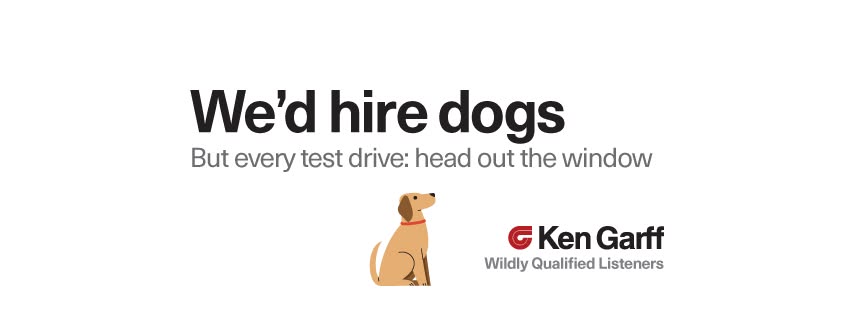
    You can see this dynamic playing out on highway billboards throughout the Salt Lake Valley. Consider the hyper-local digital campaign from the Ken Garff Automotive Group. They sell cars, yet you will almost never see a vehicle featured on their billboards. Instead, their long-running “We Hear You” slogan has morphed into their recent “Wildly Qualified Listeners” campaign featuring text-heavy, slightly polarizing dad jokes. Their current rotation features lines like: “We’d hire deer…But they keep getting caught in the headlights.” and “We’d hire dogs…but every test drive: head out the window.”
     

    Local marketers and designers love to argue over whether these signs actually make sense for a multi-million-dollar dealership group. But that debate is exactly why the strategy works, even if it’s not your cup of tea. By choosing an awkward, genuinely funny, text-focused approach over a generic AI-rendered image of a truck driving through mountains, they give commuters something to talk about on their way home.

    What 2026 Design Trends Mean for Creative Teams

    The main lesson for design teams right now is simple: stop building your brand around fleeting aesthetic trends. Build it around an authentic point of view.

    The brands that succeed over the next few years won’t be the ones chasing every new aesthetic. They’ll be the ones using new tools to express something unmistakably their own.

    Inktober 2023 with Targa

    Inktober 2023 with Targa

    Heather Steed

    Graphic Designer

    Inktober 2023 with Targa

    Another Inktober is in the rearview mirror. And while evidence of our participation exists in drawings of spiders, toads and castles, that really isn’t the point of the exercise. Each day of Inktober is an invitation to stretch, to imagine, and to brainstorm. Getting what’s in our brains onto paper can be uncomfortable, and sometimes inconvenient. That is exactly why we Inktober (can that be a verb?), and it turns out it’s pretty fun when we Inktober together.

    Enjoy this sampling of our month.