2026 Graphic Design Trends: Why Personality Wins

2026 Graphic Design Trends: Why Personality Wins

Heidi Blackburn

Heather Steed

Graphic Designer

2026 Graphic Design Trends: Why Personality Wins
A few years ago, you could spot a brand with a seasoned creative team from a mile away. Today, that boundary is incredibly blurry. High-powered digital design tools have made clean, polished layouts accessible to everyone. While that’s an advantage for quick turnarounds, it also means a visually pretty design isn’t enough to grab anyone’s attention anymore.

The most important creative shift this year isn’t a specific color palette, a trending typeface, or an illustration style. It is a fundamental pivot in what people value once everyone is using the same kinds of tools.

AI Continues to Change the Rules

For a long time, good design was heavily judged by technical execution. If you had the specialized skills to build clean vectors and perfect compositions, you won the room. Today, that execution premium has shrunk dramatically. Platforms like Canva, Figma, and Adobe Firefly have dramatically lowered the barrier to making professional-looking content.

This isn’t a bad thing. It frees creative teams from spending all their time making assets and gives them more time for strategy, which ensures design goals are met. The downside? Polished design is increasingly a commodity. Effective visual communication is the real luxury.

The Shift Toward Human-Centered Creativity

Because generative tools are incredibly good at mimicking polished aesthetics, authentic human work has become a premium asset. We all appreciate the raw efficiency of the technology, but nobody wants their brand to look like a generic corporate template. In an ecosystem where a machine can simulate a safe, sterile voice flawlessly, the work that keeps a distinct human perspective is what wins.

Josh McCowan, a designer here at Targa, put it clearly:

“The explosion of AI-generated content has created a new hunger for authenticity, not just in marketing, but anywhere design plays a role. For us, AI speeds up exploration, removes technical and artistic barriers, and gives us new ways to refine our work. But the same widely available tools that expand creativity have also introduced a new kind of sameness. Clichés can appear almost overnight. That puts a greater premium on judgment, taste, restraint, and genuineness, all qualities strong marketers and designers bring to their work. AI has been a major benefit, but standing out still requires knowing when and how to use it, and when to push beyond its limits.”

When we evaluate our work today, the question shouldn’t be “Is it clean?” but rather “Does it feel human?” That means prioritizing:

  • Real personality over corporate safety
  • Organic imperfections over sterile, mathematically perfect vectors
  • Self-aware humor and hyper-local context
  • Lived experiences and unedited photography
  • Distinct opinions or points of view
  • Clear, concise language


As AI literacy grows, knowing when not to use AI may become just as important to brand perception as knowing how to use it well. These are the creative boundaries where prompt-based often generation falls flat. They are the details that make a piece of creative work memorable and unexpected.

Why Authenticity Matters in AI-Era Design

If a campaign manages to make someone pause and feel an actual emotion, they are much more likely to remember the brand. Historically, companies tried to walk a safe middle ground—they wanted to look distinct, but never risky or unfamiliar. The current tech landscape turned that logic upside down. When everyone plays it safe with polished AI templates, they end up blending into a wall of background noise.

Brands that incorporate playful experimentation, surreal concepts or distinctive illustration styles end up having a stronger voice that stands out in increasingly similar AI-generated content.

You can see this dynamic playing out on highway billboards throughout the Salt Lake Valley. Consider the hyper-local digital campaign from the Ken Garff Automotive Group. They sell cars, yet you will almost never see a vehicle featured on their billboards. Instead, their long-running “We Hear You” slogan has morphed into their recent “Wildly Qualified Listeners” campaign featuring text-heavy, slightly polarizing dad jokes. Their current rotation features lines like: “We’d hire deer…But they keep getting caught in the headlights.” and “We’d hire dogs…but every test drive: head out the window.”

 

Local marketers and designers love to argue over whether these signs actually make sense for a multi-million-dollar dealership group. But that debate is exactly why the strategy works, even if it’s not your cup of tea. By choosing an awkward, genuinely funny, text-focused approach over a generic AI-rendered image of a truck driving through mountains, they give commuters something to talk about on their way home.

What 2026 Design Trends Mean for Creative Teams

The main lesson for design teams right now is simple: stop building your brand around fleeting aesthetic trends. Build it around an authentic point of view.

The brands that succeed over the next few years won’t be the ones chasing every new aesthetic. They’ll be the ones using new tools to express something unmistakably their own.


B2B Marketing Trends for 2025

B2B Marketing Trends for 2025

Taleen Ericksen Chief Program Director at Targa Media

Taleen Ericksen

COO

B2B Marketing Trends for 2025

As the past year comes to a close and we ring in the new year with bubbles and sparkles, Targa takes time to reflect — where we’ve been, where we’re headed, and how we’ll get there. It’s like setting a personal new year resolution like cutting carbs, recycling more, or learning a new language. But for marketing.

Here are some of our marketing resolutions for the year ahead:

1. Be a Multiplier

There’s a leadership principle that multipliers amplify the intelligence and capabilities of those around them. That’s exactly what we will continue to do at Targa. We are constant, vocal and supportive cheerleaders, therapists, even “fixers” when needed. We help our clients be more creative, solve more problems, fill knowledge gaps, and have fun being great. Our role as an agency partner is to promote creativity WITH our clients, giving them the power and space to build their expertise and flex their creative muscles to solve daunting marketing challenges and create successful outcomes. We’re here to support you 100% x a billion.

2. Harness the Power of AI with HI

AI is evolving fast. As marketers, agency side and client side, we have huge opportunities — and huge challenges — ahead of us. Did you know 75% of marketers are already experimenting with or fully implementing AI? Yet AI alone isn’t the answer. The real value lies in human intelligence (HI). Targa has been developing a team of experts who can ask the right questions, refine results strategically, and add a critical human touch to keep marketing authentic and impactful.

We see AI as a tool to enhance creativity, not replace it. Remember when tools like Hubspot once sparked fear, but ended up opening the door for a new generation of experts and specialists? Same thing. Our mission is to ask the right questions, refine the results, and add our human experience to drive smarter strategies and deliver better results.

3. Focus on the Why

Since day one, Targa has ascribed to the value of marketing with purpose. With more fragmented channels, shorter attention spans and heightened competition, all marketing must be purpose-driven. Our core philosophy advocates for a values-aligned, audience-first approach.

We channel our inner three-year-old, constantly asking Why? Why does this matter? Why will they care? Why would they engage? More often than not, that simple one-word question helps us—and our clients—look at things from a different perspective and get better results.

4. Build Deeper Relationships

This resolution is about creating a personal connection from the moment we meet till long after a project wraps. What does that mean? We care. We stay present. We ask questions and listen to answers. We look for ways to add value wherever, whenever and however we can. We dig deep, understanding the business, brand, products, processes, and people like we are part of the team. Because we are.

5. Create More Miracles

Yes we can. That’s our mindset. Whatever it takes, our goal is to delight and impress. We will do more than you think we can. We do it faster than perhaps we should. We do it for less money than seems reasonable. And we deliver better, more thoughtful solutions than you anticipate. We thrive on the challenge of turning the impossible into reality—because that’s where the magic happens.

Let’s make this year a fun and wild ride together! Get rolling with Targa in 2025! Together, we’ll navigate these trends and make our collective marketing resolutions a success.

Why AI Needs HI: Human Intelligence

Why AI Needs HI: Human Intelligence

Lisa Harmer

Campaign and Program Director

Why AI Needs HI: Human Intelligence

Artificial Intelligence is revolutionizing industries at lightning speed. As a copywriter, I used to worry that my job would be among those replaced. But after working with AI tools for our clients, I’ve realized that AI isn’t here to replace me or other content creators—it’s here to amplify what we do. For AI to reach its full potential, it needs something only humans can provide: HI, or Human Intelligence.

At Targa, we’re building a future where AI and human creativity come together to deliver incredible results. Here’s how we make the AI-HI partnership work for our clients.

1. AI is a Starting Point, Not the Final Destination

We use AI to kick-start the creative process, to help brainstorm ideas and shape rough drafts. Think of it as an advanced brainstorming session: AI gives us a foundation, but it’s often awkward, incomplete, or a bit “off.” Before AI, we’d flip through old campaign books, scour competitive ads, or dive into a donut-fueled brainstorming session with the team. Now, we can get some quick initial ideas from AI, but those ideas only shine once we apply our creative instincts and insights to bring them to life.

2. AI Needs Thoughtful Direction

Just like a team member, AI performs best when guided. We carefully train our AI tools to understand each client’s brand guidelines, messaging, tone, and product details. This involves crafting and refining prompts, trial and error, and continuously tweaking the inputs to ensure AI aligns with our clients’ voices and needs. It’s thoughtful, scientific, and ongoing—a partnership that grows smarter and more precise with time.

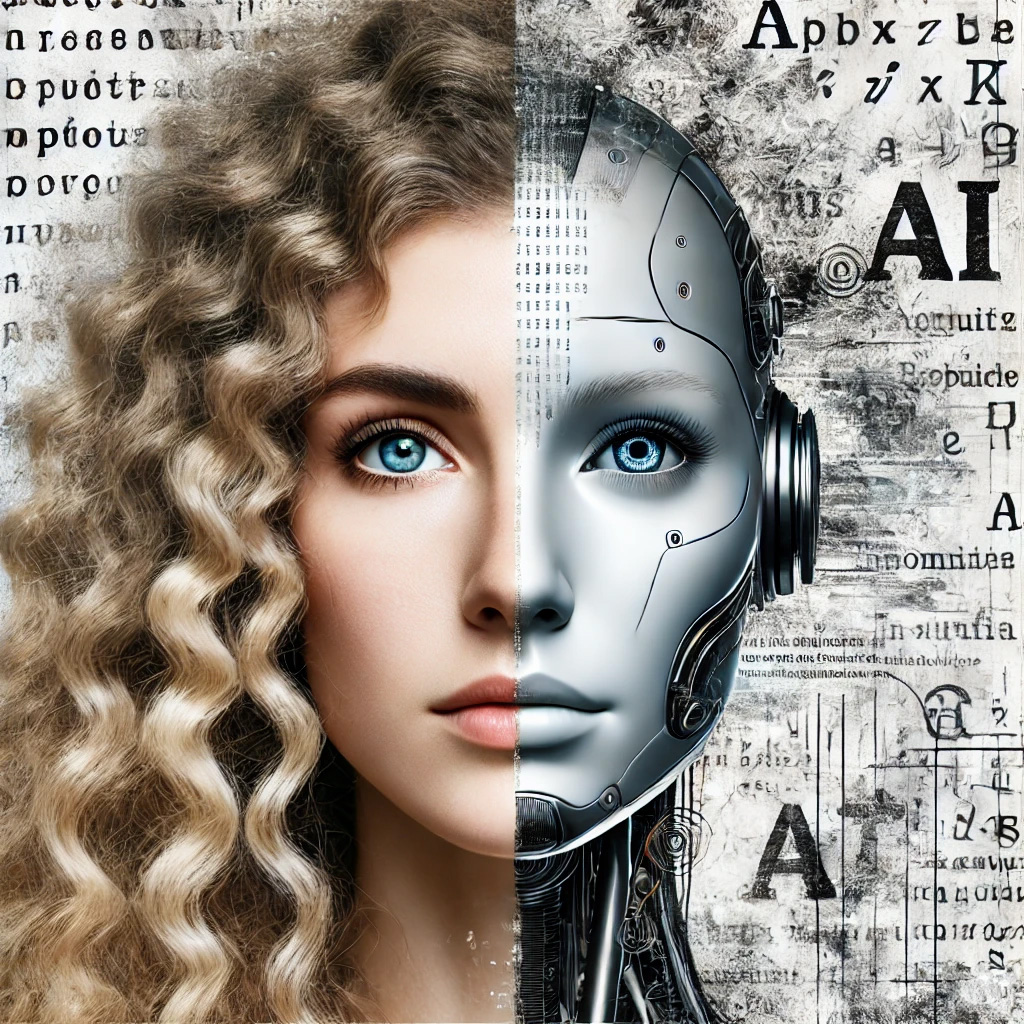
Lisa as Cyborg dall-e 1040x1040

3. AI Excels at Editing and Proofreading (But It Can’t Replace Our Voice)

Let’s face it: reviewing content repeatedly can make anyone’s eyes glaze over, and mistakes can slip through. AI’s mechanical precision is perfect for catching spelling errors, grammar slip-ups, and readability issues. However, it lacks the personality and nuance that connects with audiences on a human level. This is where HI shines—adding the voice, character, and empathy that make content truly engaging.

4. AI Sometimes Just Doesn’t “Get It”

We’ve all been there: plug solid information into an AI tool and receive something…strange. Maybe it’s nonsensical, inaccurate, or just a little “off.” That’s because AI can’t understand industry-specific subtleties, competitive dynamics, or market nuances the way we do. Our expertise in the product’s features, value propositions, and brand story creates a final layer of context that AI simply can’t replicate.

5. Context is Key—for AI and HI

One of our biggest challenges is when clients give us minimal details for a project. Without background information or critical insights, it’s tough to create high-value, on-target content. The same applies to AI—it’s not a silver bullet. To get the best results, AI and human teams both need the right tools, data, and context to generate powerful marketing solutions that truly resonate.

6. AI is a Tool, Not Our Bottom Line

At Targa, we bill for time and materials only. Using AI helps us work faster and more efficiently, which saves our clients money. For example, if a project once took six hours of research and drafting, we can now harness AI to handle research and then apply our HI expertise to refine and complete the draft in two hours. The result? Projects go to market faster and leave room in your budget for more campaigns.

Embracing the AI + HI Power Duo

The future of marketing isn’t about choosing between AI and HI; it’s about embracing both. AI can help us streamline, ideate, and edit, but the heart, creativity, and strategic thinking that make content powerful and engaging will always come from humans. At Targa, we’re proud to use the AI-HI partnership to deliver unique, effective, and high-impact solutions that drive results for our clients. PS…this content was generated by a human, run through an AI editor, reviewed and personalized by more humans. AI+HI at work!

Jason’s Take

We’re all paying big-time attention to how AI supports creative services. AI is a powerful expediting tool for us—and for our clients. To further explain, the fundamental principles of Targa’s marketing and creative services are the same today as when we opened our doors in 2002. We start by aggregating all influencing data—relevant and irrelevant—with the help of our clients and their customers. We then craft on-target messaging (storytelling) and media (delivery tools) with right-time and right-place campaigns.

Today’s AI tools expedite that same aggregating process, capable of swiftly producing both relevant and irrelevant messaging. Our AI-supported human-listening and human-sifting process is no less deliberate and strategic today. AI can often accelerate our collaborative right-time and right-place model. For our clients, this acceleration to market also means fewer billable hours to deliver meaningful campaigns.

What Focus Helps us See, and Makes us Miss

What Focus Helps us See, and Makes us Miss

Jason Steed

Owner & CEO

What Focus Helps us See, and Makes us Miss

The Best Ideas are Often Outside our Focus…

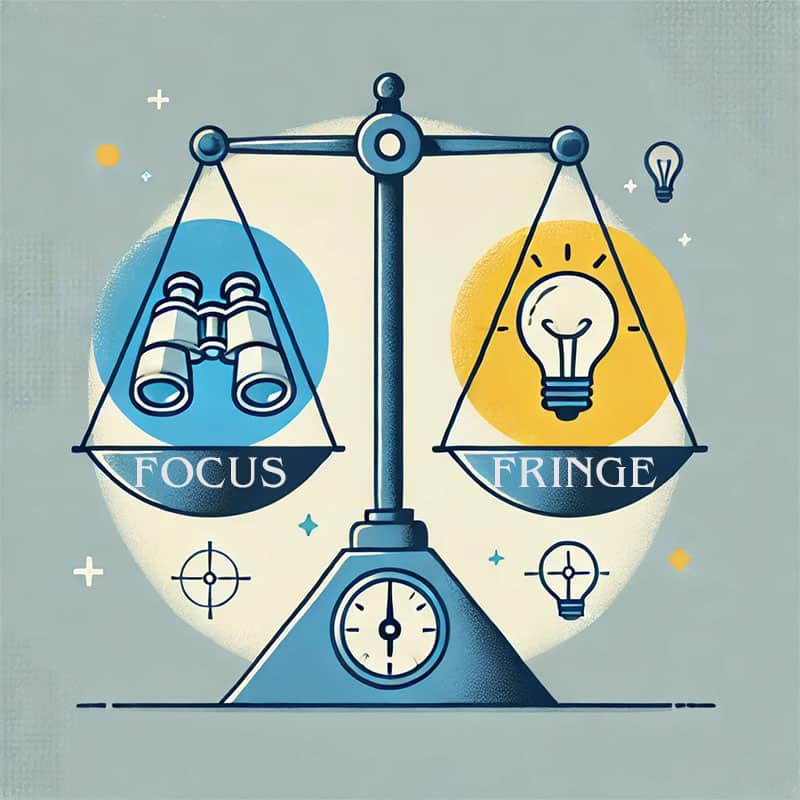
Strange how the best ideas live where you’re not looking. So how do we creatives and marketers benefit from focus and structure? I’ve found that focus is step 1 to great creative, and step 2 is looking outside of those crosshairs. Here are ideas for spotting where the great ideas like to linger.

Balance the Macro With the Micro

I spent an evening with great marketing minds at the Utah Olympic Oval, sponsored by Silicon Slopes. I had never picked up a curling rock before (you don’t actually ever pick them up), and I gained a big respect for the game. While trying to keep my balance in launching “the rock,” I understand now why curling requires conditioning, stamina, and lots of focus. While focusing on the pinpoint instructions from my teammates, it got me thinking about the balance between focus and making room for the bright ideas lurking in our periphera.

For me, focus is critical for setting the guide rails to a project. Focus creates the fenceline perimeter where great ideas hang out.

Products on the shelf

You’d be amazed how both the micro (focus) and the macro (wide-angle view) bring variety and creativity to an anything-goes brainstorming session. The big picture ideas appear at the borders of your idea cloud—alongside the bizarre, goofy, cliché, and downright dorky ideas. Focus defines those borders, and, de facto, the sweet spots along the borders. At the same time, too much time ruminating on the big picture creates fun yet mostly irrelevant ideas.

This balance is crucial in our line of work. We need focus to keep us off thin ice and to push through the challenges and see a project to completion. But without leaving space for creativity, we risk missing out on those unexpected game-changing ideas. Here are some tools to help you spot those great ideas lurking in the wings:

Products on the shelf

Strategic Balance

1. Time Blocking: Yes, you can actually schedule creative time. I dedicate specific “focus time” in my day. For me it’s During these blocks, shut out distractions and focus entirely on the task at hand. This helps build the momentum needed for high-quality work.

2. Pomodoro Technique: Work in short, focused bursts (like 25 minutes), followed by a 5-minute break. I’m THE WORST at this! Truly, my OCD nature gets me stuck in ruts all of the time, though I know this method keeps creative minds sharp and ready to catch those peripheral creative ideas.

3. Scheduled Brainstorming Sessions: Set aside regular time for brainstorming. Whether it’s a solo session or with a team, these unstructured moments can lead to the breakthroughs you’re seeking.

4. Environment Switching (my favorite): If you’re feeling stuck, change your environment. Whether it’s moving to a different room, taking a walk, or even working from a café, a change in scenery can spark fresh ideas. Truthfully, my best ideas come to me when I’m miles away from my laptop with my labradoodle Pepper. Usually a lunch break does the trick.

Alongside focus, step back to find those great ideas that hang out in the fringes.

5. Journaling: Keep a journal (a.k.a. Notes app) to jot down any ideas, no matter how small or seemingly unrelated. Revisiting these notes later can often lead to surprising insights and new connections.

My Example Story on Focus

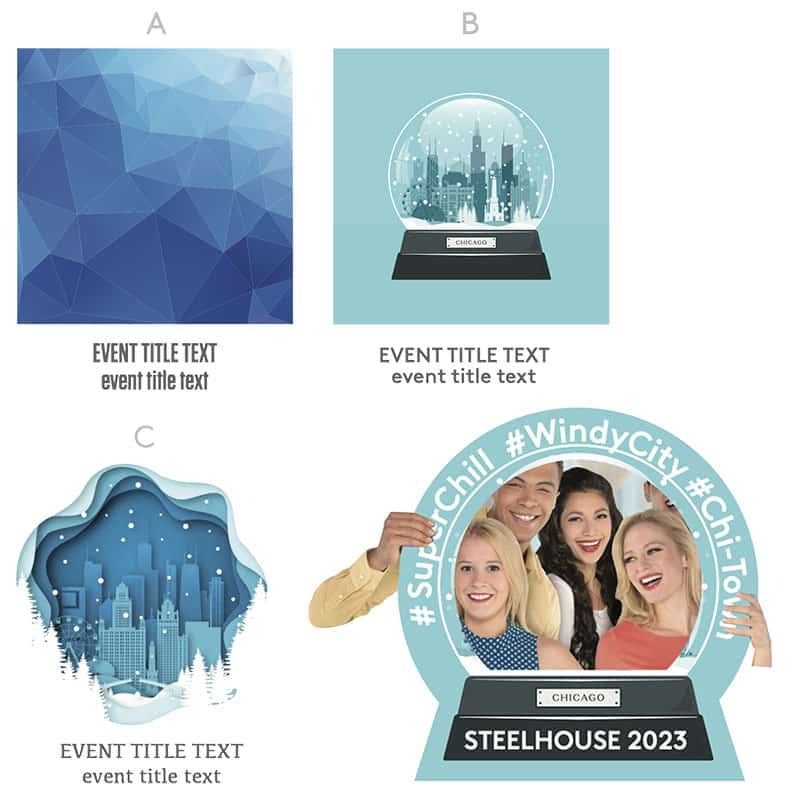
Moodboarding is a visual storyboarding tool to Targa uses early on in our team’s creative process. We have the chance to pull our clients away from sharp focus to discover some fringe ideas for their projects. Targa helped one of our technology clients brand a hosted on-site event. Ryan on our creative team led out with our creative team on some moodboard exploration, helping to mature a concept that melded crystal with organic design elements. From this exercise, our client supported our out-of-the-box theming for a variety of event materials, from invitations to floor displays, to a selfie station.

Products on the shelf

Tie it All Together

By balancing structured focus with intentional space for creativity, you’ll be better equipped to produce work that not only meets expectations but exceeds them. I’m curious what your go-to creative strategy looks like.

Moving Others with Motion

Moving Others with Motion

Ryan Snarr

Ryan Snarr

Creative Lead

Moving Others with Motion

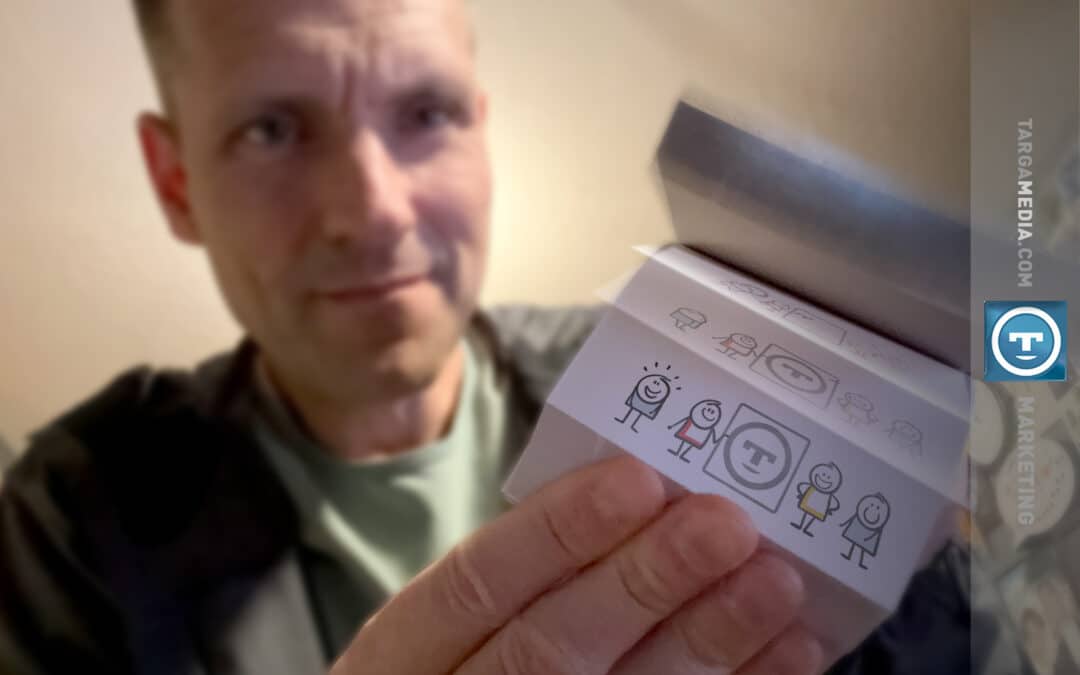
We’re always looking for ways to implement interactivity and movement into things that we design. A good example of this is the latest edition of our promotional notepad. Who doesn’t love a flipbook? A simple pad of paper becomes memorable when people engage with it by flipping through its pages.

Quick question: When you interact with a flipbook, do you flip the pages upward towards your face or do you flip them downward away from you? You’d be surprised at how passionate some can be on this topic.

In this case, our flipbook depicts an illustration that animates to show the ‘T’ in Targa’s logo coming together. This idea is so simple and it has been around for ages. Honestly, who doesn’t remember drawing their own stick figures in their textbook, encyclopedia or pad of sticky notes just to try their own hand at basic animation? This nostalgic factor can be the glue in your sticky marketing.

Of course ‘sticky marketing’ is just a phrase until you can assign some actual marketing numbers to it. An A/B test done by VistaCreate demonstrated the objective, real life number results below:

“As you can see, our animated ad attracted 1.5x more clicks than the static image. This made our cost per click drop 50%. And despite our animated ad reaching notably less users – 18 thousand for video vs 25 thousand for the static ad, the number of clicks on our advertised link was more than double for the animated ad – 325 clicks vs 145 clicks.”
To introduce some new words into the conversation, the company Linearity shares the idea of turning information into visual content. Their About Us page takes a beautiful and simple approach at this. They don’t throw animated gifs at their audience, but have crafted their message to move in an engaging way as the viewer scrolls through at their own speed. A+ for excellent storytelling.

There are many different levels of motion that can be incorporated into marketing. From full fledged video and animations to small gif files. Targa’s signature signature images are an example of really simple graphics that catch the eye with movement.

If there is something I like as much as a motion graphic, it’s a nice list. Here’s 10 reasons to consider putting your next idea into motion.

1. Chop through the clutter:

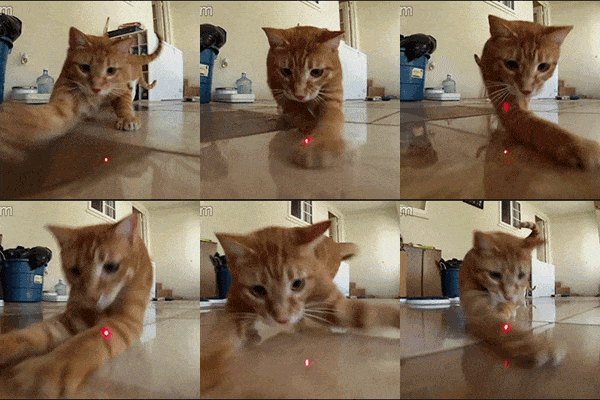
Like a sneaky ninja, motion grabs attention faster than a cat chasing a laser pointer.

2. Java Jolt:

Who needs coffee when you have motion graphics to wake up the eyeballs?

3. Storytelling Sorcery:

Disarm your audience with moving narratives that would even make Harry Potter go, “Expelliarmus!”

4. Fisherman’s lure:

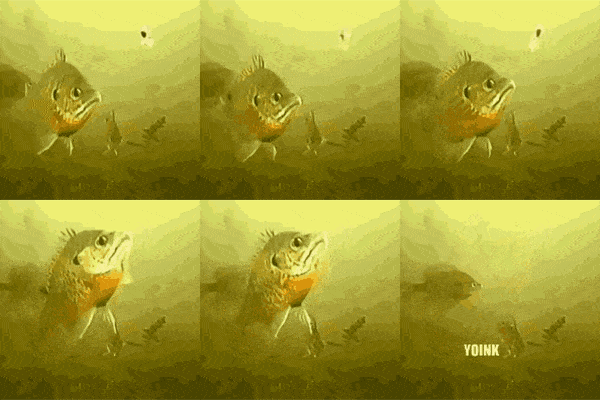
Move it or lose it—motion keeps your audience hooked like a fish on a reel.

5. ‘Digital’ Engagement:

 Get those thumbs tapping and hearts racing with animations that scream, “Like me!”

6. Visual Voodoo:

Turn mundane into magic with motion—still can be stale when you only have a split second to make an impression.

7. Brand Boogie:

Show off your brand’s dance moves and make competitors feel like wallflowers.

8. Memerable Marks:

Leave a lasting impression like a lipstick stain on a white shirt—intentional, of course.

9. X Marks the Spot with Motion:

Make users feel like they stumbled upon buried treasure—click, explore, repeat!


10. Roll out the Runway:

Give the red carpet treatment to your ideas and let them strut their stuff in motion!

Serving Your Customers with AI

Serving Your Customers with AI

Ryan Snarr

Content Lead

Serving Your Customers with AI

This article is part of a series. Read Part 1, Processing Targa’s Processes here.

Unless you truly disconnect from all things digital, you’re likely to see evidence, or mention, of some form of AI on a daily basis. This technology is being explored from every aspect of business from customer service to sales. AI is here to stay. How are you feeling about it? Here we’ll explore why it is making its way into our way of doing business and how using it effectively benefits businesses and their customers.

Artificial Intelligence is…

“…making a machine behave in ways that would be called intelligent if a human were behaving”
John McCarthy – Computer Scientest who coined the term Artifiial Intelligence in 1955.

The idea of AI has been around for over a half century, but given the fact that we all run around with tiny computers in our pockets and purses, its effects today are far more reaching than conversations amongst computer scientists. Within the topic are other subsets, like Machine Learning (ML) and Deep Learning (DL), that range in complexity and capability. For all intents and purposes, we’ll lump it all under the banner of AI as we explore how it can have an influence on our efficiency, creativity and education.

…Is on my list.

For whatever reason, I love a good list. A nice long list of 100 items warms my heart. I pride myself in making lists quickly for things both trivial and noteworthy. From my 100 favorite movies to 100 cherished memories, I’ve searched the corridors of my brain to be proficient and thorough on a variety of random topics. 

The tables turned when I discovered that anyone could generate similar lists using Chat GPT and get their results faster than they could pick up a notebook and a pencil.

These AI generated lists can be objective and factual, but they can ALSO be something completely original. Try asking it ‘100 ways to say I love you incorporating dad jokes and tacos’. I can then refine or tweak that list with subsequent prompts. It’s not just lists either. You can write prompts to create jokes, computer code, images and advice. Results are returned in seconds. AI is doing for our brains what the microwave did for our dinner, but with AI you can insert an Italian pasta and get out a Chinese stir fry if you’d like. The bottom line is this AI assistance acts fast which adds speed and efficiency to whatever you’re doing. Customers love efficiency. It saves them time and money they can then redirect elsewhere.

Products on the shelf

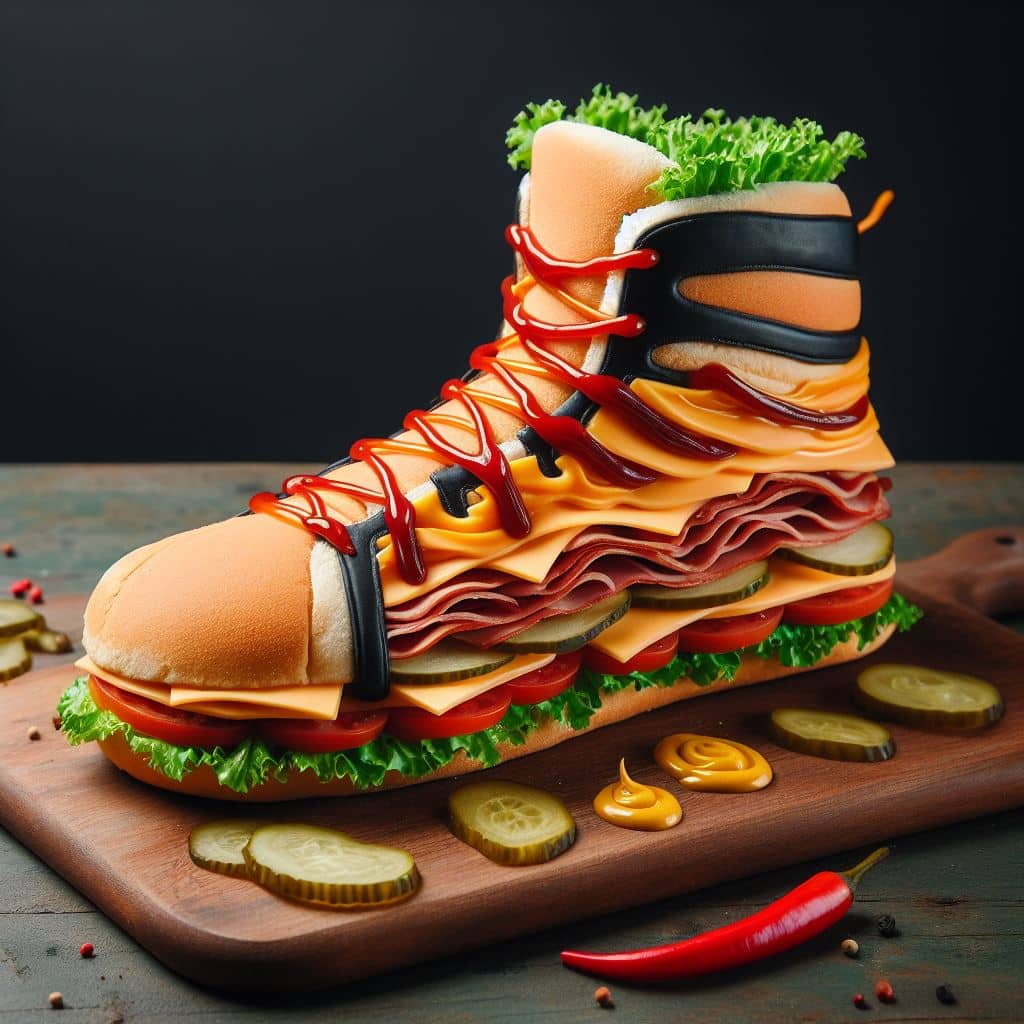
A sub sandwhich that is made to look like a high-end baskteball shoe

Diversified thinking

Not only will AI unlock opportunities in efficiency, but for a visual person like myself, it can be a lot of fun to use in the image generation space. Any crazy combination you can think of can be spat out of an AI platform lickety split. This proves to be a fantastic way to brainstorm for yourself, or others.

Products on the shelf

Mona Lisa driving a Formula One car across a race track with cinnamon roll pavement. The moon is smiling overhead.

In some cases, designers like Seva Simone are even touting the idea that their effective use of AI has led them across an evermore thorough landscape of ideas to develop their product. Much like populating completely original lists, this visual, computer-generated output can be created quickly.

However, speed isn’t always what makes these images the most valuable. These images often depict subjects in a way you wouldn’t necessarily have imagined. Harnessing the range of diversity AI can make available to you serves the creative process. This has trickle-down benefits for customers paying for creative services. Not only can they feel confident you’ve brainstormed thoughtfully in predictable pastures of thought, but they also benefit from diverse outside-the-box thinking aided by AI assistance.


An AI Education

If efficiency and creative diversity weren’t enough to get you implementing aspects of AI into your world, let education be the thing that tips the scales. Heck, go ahead and just ask Chat GPT how you can incorporate it to benefit your life. It’ll come up with a list of things to sell its services to you. This fast track toward self education can pay off in step-by-step tutorials or references to validated sources of information.

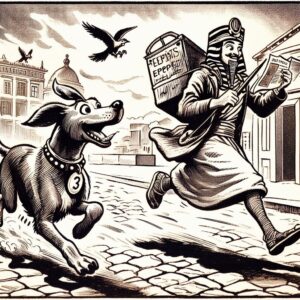
Quick Tip: To add to your AI experience when writing image prompts, consider the ‘Subject > Details > Style’ model. Try to be as specific as possible without being too wordy. Your results will be more predictable the more clear-cut your prompt is.

Example: A dog > silk screen, cartoon, comic book, Egyptian, 1800s > chasing a mailman.

Products on the shelf

Design a dress with luxurious
European vintage style.

AI’s source

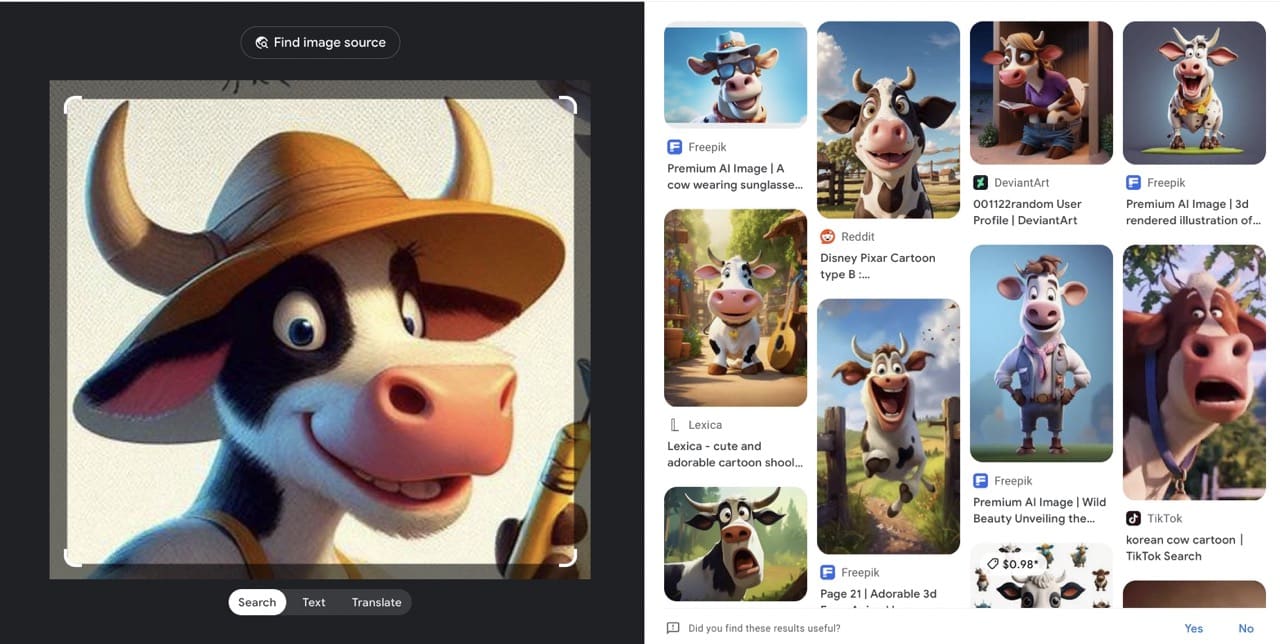
In a previous blog post, we teased the idea of reverse searching images we created through AI engines to find where the inspiration stemmed from. Unfortunately, there were no decipherable exact matches or direct ties to artists or images that could clearly explain all the computer’s decisions.

Here is a screenshot of something AI kicked over to us on the left in the black border. To the right you see images that popped up when we did a reverse image search. While there are some similar characteristics in cartoonish cows, we don’t see one particular style or color palette modeled entirely. Subsequent searches yielded similar results.

Harnessing AI for the overall good

Through personal use and even in composing thoughts for this article, I’ve confirmed once again for myself the incredible potential AI has as a fixture in our society. I really should be determining how I could use it more. I do get a sense however, that this innovation’s positive societal contribution must be unlocked carefully. Much like harnessing the power of fire, its use should be bridled since those in control are fallible human beings. Influencer @ElleCordova illustrates this with humor in this YouTube short titled, ‘Inventions Hanging Out’. Did you feel what I felt at the end when ‘AI’ looked directly into the camera?

Products on the shelf